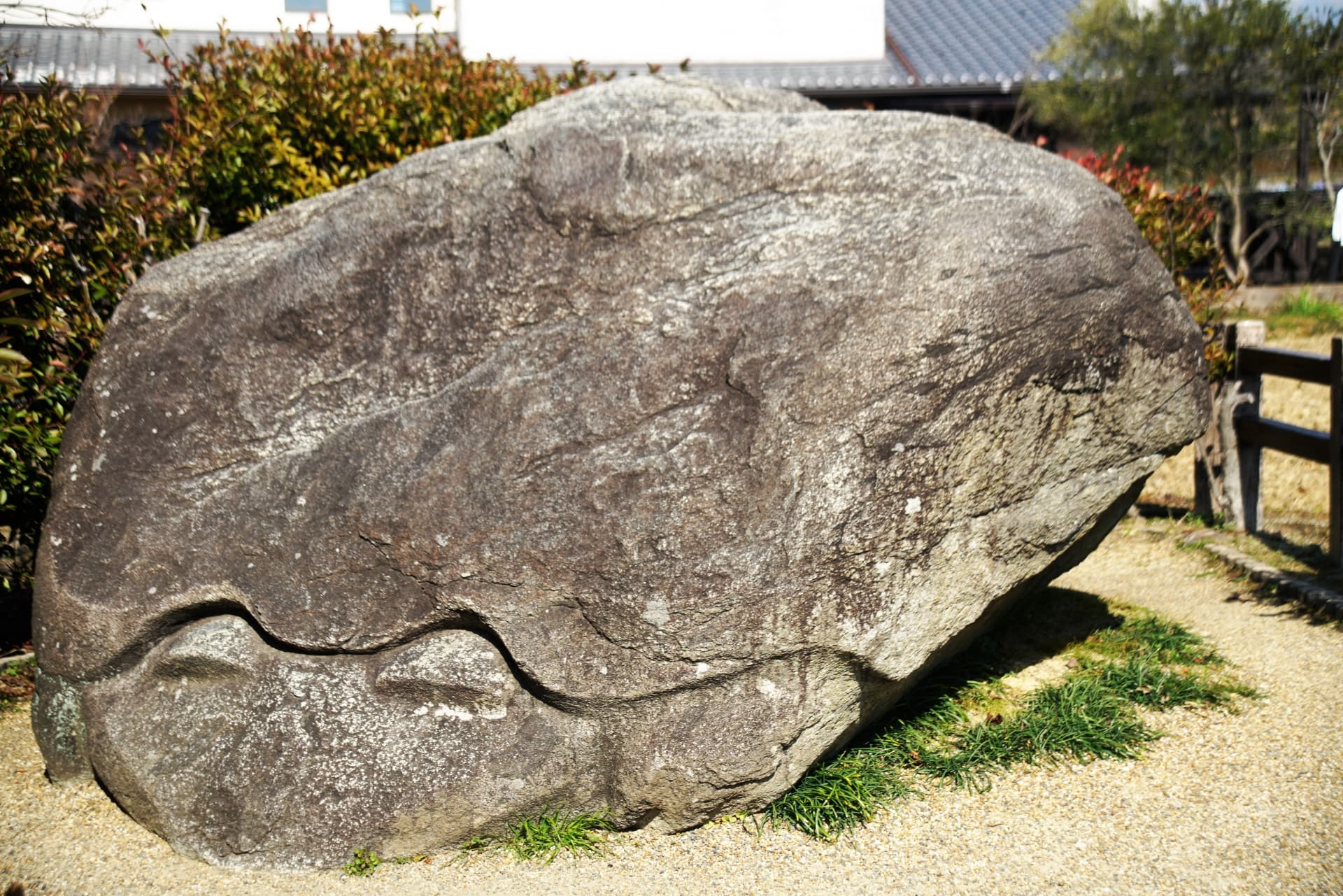
In Asuka, there is a stone that no one has understood for 1,400 years.
It sits near the edge of a rice field — roughly turtle-shaped, about 3.6 metres long, weighing approximately 10 tonnes. No one knows who made it. No one knows why. No one knows exactly when.
1. What Is Not Known
The Kameishi — the Turtle Stone — sits in a field in the Kawara district of Asuka village. It is generally attributed to the Asuka period (roughly 6th to 7th century AD), when Japan was absorbing Buddhism, writing, and vast cultural influence from the Asian continent. Beyond that, almost nothing is established.
One theory holds that it was carved by craftsmen from Silla, the ancient Korean kingdom that maintained close ties with the Yamato court during this period; the Asuka region had significant populations of people descended from continental immigrants. Another suggests it served as a boundary marker for the Kawaradera temple complex that once stood nearby. A third holds that it was an unfinished sculpture, abandoned midway. None of these has become the accepted view.
Rice stalks sway. A tractor sounds somewhere in the distance. In 1,400 years, no one who has stood before this stone has had an answer.
2. When It Faces West, Yamato Will Sink
A legend attached to the Kameishi has circulated since at least the medieval period. Long ago, this land was a lake. The lord of the Kawara waters — a great catfish — and the lord of the district across the water — a great serpent — fought a long battle. The serpent won and carried the lake's water away. The lake dried up, and all the turtles in it died. The villagers, out of pity, carved this stone in their memory.
The stone has not always faced the same direction. Records suggest it once faced north, then east; it now faces roughly southwest. A prophecy is attached to it: when the Kameishi faces west — toward Toma — the entire province of Yamato will sink beneath the sea. Yamato is the ancient name for Nara Prefecture, the original heartland of Japanese civilization, where the country's first permanent capitals were established. The idea that this land might one day disappear into water carries a particular weight.
No record documents when the stone changed direction each time. It was simply found to have moved. Geological surveys of the Kame-no-se rapids area on the Yamato River have confirmed evidence of large ancient landslides that temporarily dammed the river, flooding parts of the Nara Basin. The legend of the vanishing lake may be carrying a memory of an actual geological event, passed down across centuries in the form of a story.
3. Why a Turtle
In the cosmology that the Asuka court inherited from the Asian continent, the turtle was one of four divine beasts guarding the cardinal directions. The Genbu — the Black Tortoise, usually depicted entwined with a serpent — was the guardian of the north. A painting of the Genbu survives on the north wall of the Kitora Tomb, a 7th-century burial mound also in Asuka village, discovered in the late 20th century; the Kitora murals are among the finest surviving examples of ancient Japanese decorative painting. The artists are unknown.
The connection between the Kameishi and Genbu cosmology has been proposed by some researchers, though it remains unestablished.
On the way back, I turned to look at the stone one more time. It was still facing whichever direction it faces — still offering no particular clarity.
There is also this: the name "Kameishi" — Turtle Stone — may be leading us to see a shape that may or may not be there. Some researchers have noted it could be positioned upside down. Others, based on the triangular face with protruding eyes, have proposed it might actually be a frog. The more carefully you look at it, the less certain you become. This seems to have been true for 1,400 years. It may be the most honest thing about the stone.