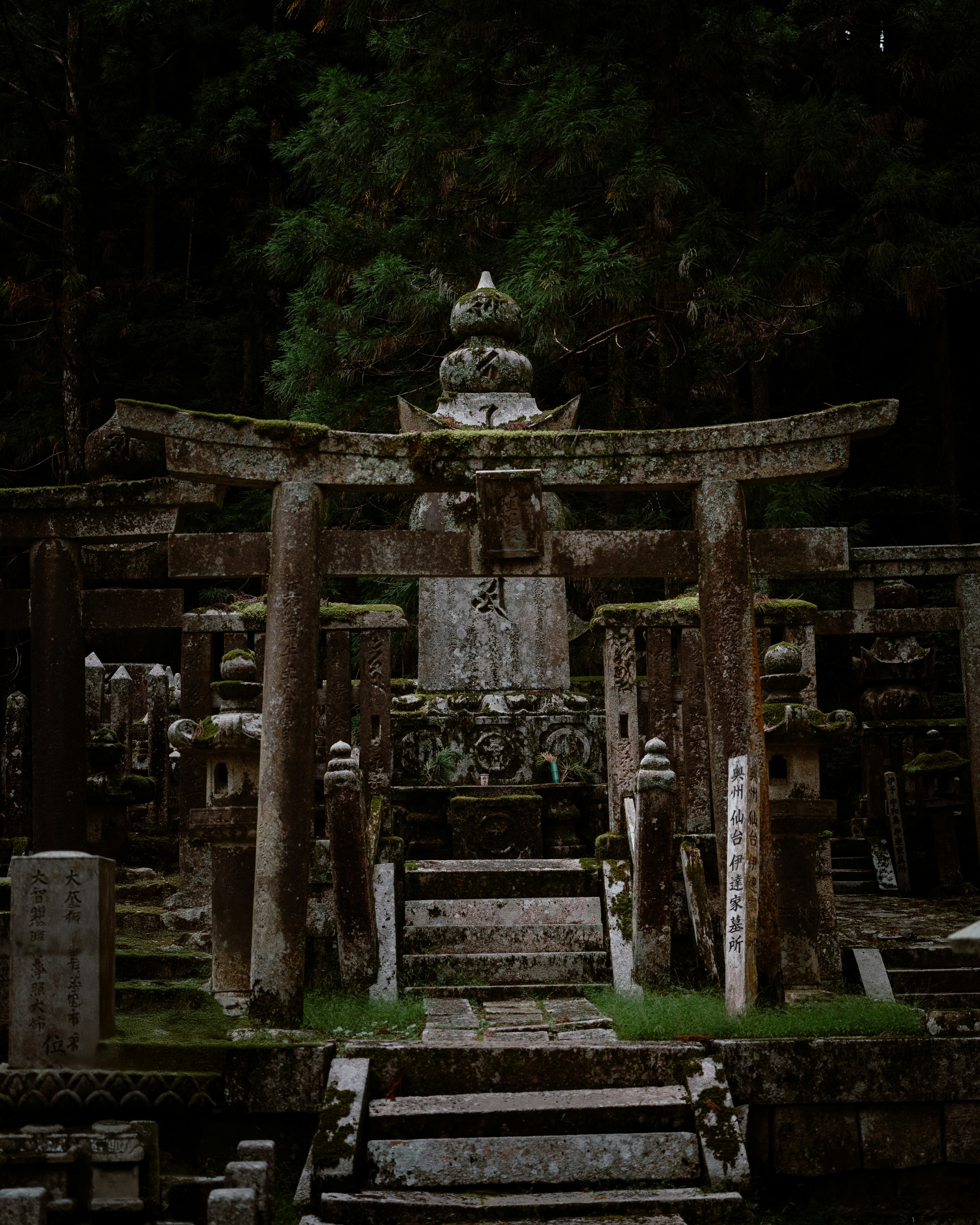
When you enter the path through Okunoin, the air changes. The cedars grow taller, the light shifts, and your footsteps grow quieter against the stone. Stone lanterns line the path on both sides. For reasons that are difficult to account for, you find yourself walking more slowly.
1. There Are Things That Cannot Be Written Down
Kukai — the Buddhist monk who would become one of the most revered figures in Japanese history — did not sail to Tang China in 804 AD in search of scriptures. The scriptures already existed in Japan. Copies, translations, and commentaries.
What he sought could not be conveyed through texts. Mikkyo — Esoteric Buddhism — holds that its deepest teachings are transmitted orally and physically, from master to disciple, in person: through voice, gesture, and bodily presence. To write the transmission down is, in a sense, to lose it. So Kukai had to go where the living teacher was — not to stand before books, but to stand before a person.
He crossed the sea.
2. "I Knew You Were Coming"
At Qinglong Temple — the Green Dragon Temple — in Chang'an, the Tang capital, Kukai met the monk Huiguo for the first time in the summer of 805. Huiguo was fifty-nine years old and had spent his life as the foremost transmitter of Esoteric Buddhism in China. According to the records Kukai himself later wrote, the old master greeted him with these words: Wǒ xiān zhī rǔ lái — "I already knew you were coming."
Why he said this, no record explains. To the Chinese disciples surrounding them, it must have been incomprehensible — an elderly master, speaking this way to a young foreign monk he had never met. The words are recorded; the reason is not.
The first words between them were: "I knew you were coming."
3. Everything, All at Once
Esoteric Buddhism as transmitted in Tang China had two great systems — two bodies of teaching that together described cosmic reality from complementary angles. The Taizokai, the Womb Realm, represented the compassion of the cosmic Buddha; the Kongokai, the Diamond Realm, represented cosmic wisdom. Each was expressed as a vast mandala — an intricate cosmological diagram, mapping all Buddhas and bodhisattvas in their relationships to each other and to the universe. In the Esoteric tradition, a mandala cannot be understood from the image alone; its meaning must be received through initiation and direct transmission. By established convention, no master had ever transmitted both systems to a single disciple simultaneously.
Huiguo gave Kukai both.
That December, Huiguo died. Perhaps there was no time remaining. Perhaps Kukai was the only disciple capable of receiving the complete transmission. Perhaps both are partly true. There were things that could not be written down, and a life was ending, and so they were given all at once.
Huiguo (746–805) was the definitive heir of Esoteric Buddhist transmission as it had traveled from India to China. According to his own recorded words, transmitting everything to Kukai was the fulfillment of his life's purpose.
Kukai is said to be still present at Okunoin in Koyasan. Not dead, in the Shingon Buddhist understanding, but in a state of deep meditative absorption called nyujo — waiting, in unbroken meditation, for the arrival of Miroku, Maitreya, the Buddha of the future. Monks bring him food every morning. They have done so without interruption for over 1,200 years. At the end of the cedar path, before the mausoleum, I stopped for a moment. A lantern was burning. Someone nearby had their hands pressed together. These small things felt, somehow, as if they had always been happening.