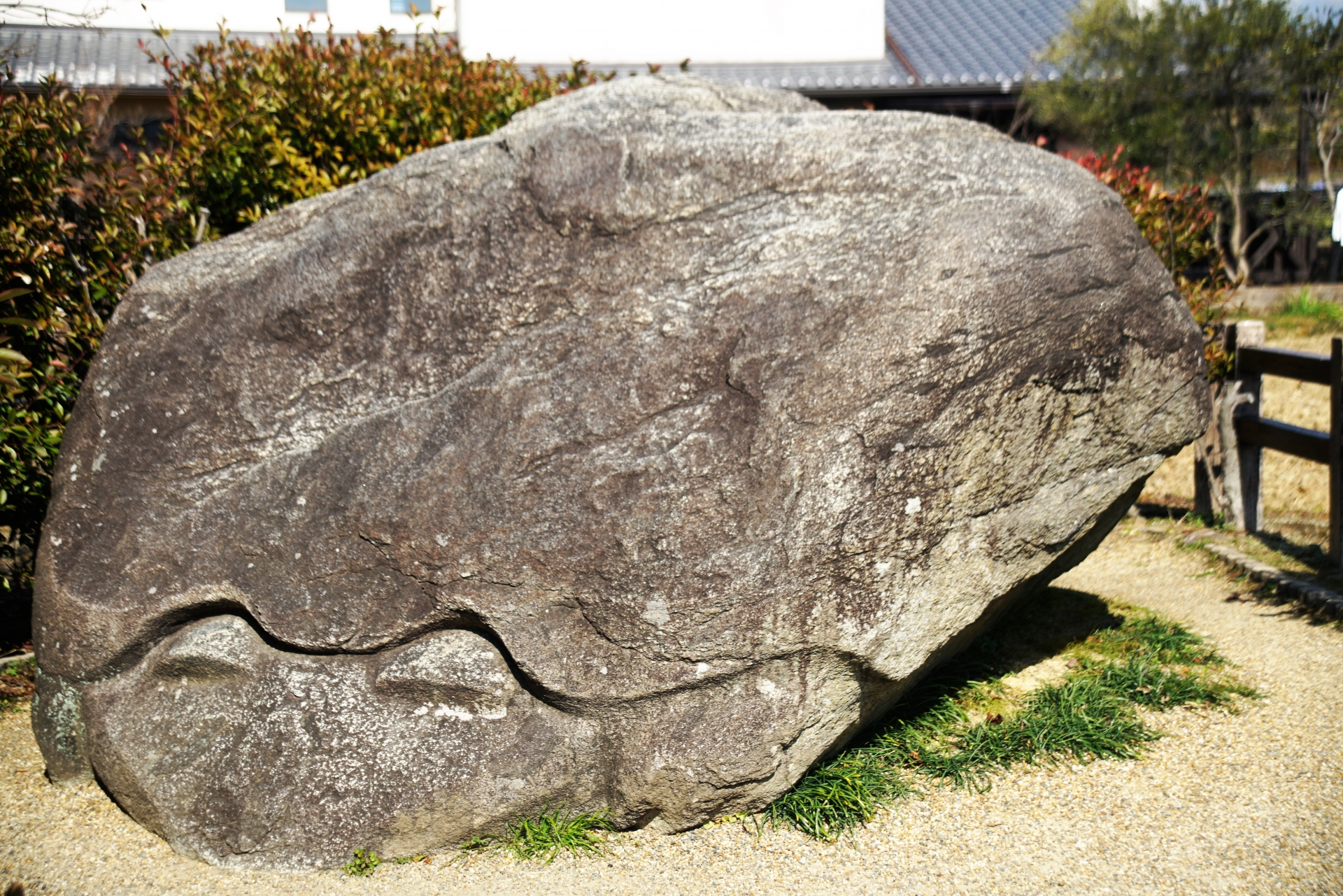
The Turtle Stone
hasn’t turned
west yet.
A stone in Asuka that no one has understood for 1,400 years
In the middle of a rice field, there is a ten-ton block of granite.
Who made it — unknown. Why — unknown. When — unknown.
The Kameishi — Turtle Stone — sits beside a field path in Kawahara, Asuka village. Length 3.6m, width 2.1m, height 1.8m. Estimated to be from the Asuka period (6th–7th century). Beyond that, almost nothing is known.
There is a theory that stonemasons from Silla carved it. A theory that it was a boundary marker for Kawahara Temple. A theory that it was abandoned partway through carving something else. None carry strong evidence. None have become the accepted view.
In 1,400 years, no one who has stood before this stone has had an answer.
This whole area was once a lake, the legend says. The great catfish of Kawahara and the great serpent of the opposite bank, Taima, fought a long battle. The serpent won and carried the water away to Taima. The lake dried up. All the turtles living there died. Moved with pity, the villagers carved this stone to honour them.
The Turtle Stone once faced north. Then east. Now it faces south-southwest. A prophecy holds: when the Turtle Stone faces west — toward Taima — all of Yamato will sink beneath a sea of mud. It is currently one direction away. When it last changed facing, no one recorded. People simply noticed, at some point, that it had.
This legend has unexpected geological support. A survey of the Kame-no-se gorge on the Yamato River (Kashiwara City, Nara) confirmed that a massive ancient landslide once dammed the river, turning part of the Nara Basin into a lake. “Yamato was once a lake” may be a memory of a geological event from more than 1,400 years ago.
“When it faces west, Yamato will sink beneath mud.” It is currently one direction away.
Kame-no-se has long been known for repeated landslides. In the 1931–32 collapse, the Yamato River was completely blocked. The Ministry of Land, Infrastructure and Transport continues landslide control work there today. Geological surveys have confirmed traces of similar blockages in antiquity.
In the Asuka period, the turtle was Genbu — one of the four guardian deities of the cardinal directions, assigned to the north, depicted as a turtle and serpent entwined. A Genbu mural survives on the north wall of the stone chamber of Kitora Tomb (late 7th to early 8th century), in the same Asuka village.
The hexagonal pattern of the turtle’s shell symbolised good fortune and long life. Divination by heating a tortoise shell and reading the cracks — kibo — was practised at the imperial court. The turtle was a spiritual intermediary: not merely an animal, but a being that embodied direction, time, and divine will.
Records from the period indicate that 80–90% of the population of the Asuka region were descendants of immigrants from Baekje and Silla. Most of the mysterious stone structures are thought to have been made by these continental immigrants. The choice of the turtle form is deeply tied to the cosmology they brought with them.
One more thing. A survey by the Nara National Research Institute for Cultural Properties raised the possibility that the stone may be placed upside down. And given the face — triangular, with protruding upper eyes — there is also a “frog theory.” The name Turtle Stone got there first. Whether this stone actually depicts a turtle, no one has confirmed.