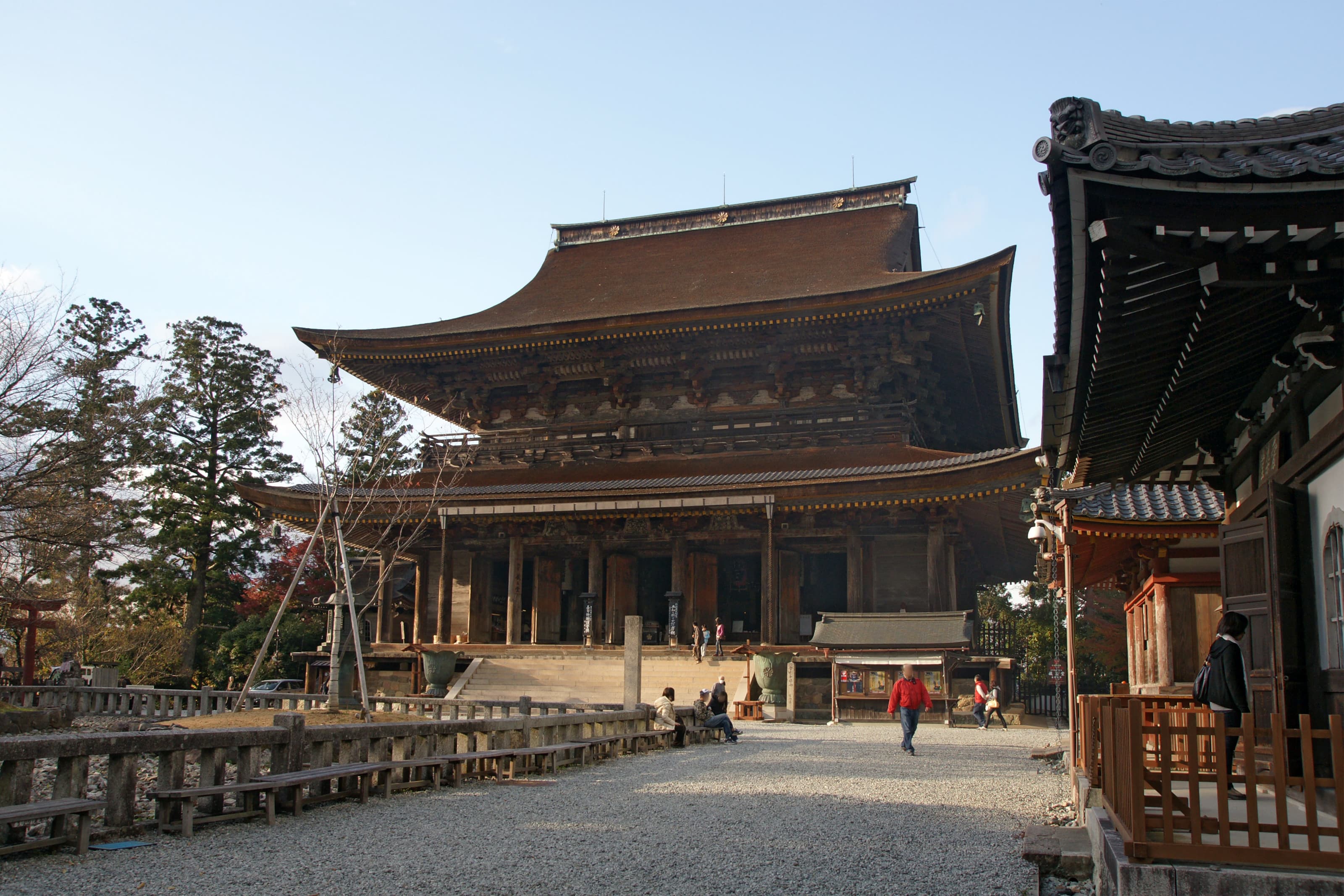
Halfway up Mount Yoshino, in southern Nara, stands the Zaodo, the main hall of the temple Kinpusen-ji. At the back of the hall are three tall cabinets, their doors usually shut. Inside each stands a figure more than seven metres high. Its skin is blue. Its hair stands on end. Its right foot is raised in the air. Its name appears in no scripture from India, and in none from China.
1. Not in the Scriptures
The figure is called Zao Gongen, or in full, Kongo Zao Daigongen. Buddhist images normally trace their form and their name to scriptures composed in India. The historical Buddha does. So do Kannon and Miroku. Zao Gongen has no such source. It is held to be a deity without scriptural basis, born in the mountains of Japan.
The temple tells the story this way. In the seventh century, En no Gyoja, the ascetic regarded as the founder of Shugendo, the Japanese tradition of mountain practice that blends Buddhism with older mountain worship, spent a thousand days in seclusion on the summit of Sanjogatake in the Omine range. He prayed for a deity who could save a disordered world. First Shakyamuni, the historical Buddha, appeared. Then Kannon, then Miroku: three figures for the past, the present and the future. En no Gyoja went on praying. The three were too gentle, he judged, for the people of a violent age. At the end of his prayers, with a clap of thunder, a figure of wrath appeared. That was Zao Gongen.
The earliest name that can be traced in documents belongs to the ninth century. Shobo, the monk who founded the temple Daigo-ji in Kyoto, is recorded as having made three images on Mount Kinpu, and one of them was a "Kongo Zao Bosatsu". It is considered reasonable to date the deity's emergence to about that time. The vision of En no Gyoja is temple tradition; the image belongs to the Heian period. Either way, the birthplace is the same: the mountains between Yoshino and Omine.
2. Blue Skin, an Angry Face
The three figures in the Zaodo measure 7.28 metres for the central image, 6.15 metres for the one on the viewer's right and 5.92 metres for the one on the left. They are carved from wood and designated Important Cultural Properties. Inside the head of the central figure is an inscription in ink: the date, the nineteenth day of the eleventh month of 1590, and the names of the master sculptors Sotei and Soin of Nara. The images were made at the same time as the hall around them was rebuilt.
All three take the same pose. The right hand holds up a vajra, a ritual implement of esoteric Buddhism said to shatter evil. The left hand rests at the hip in a gesture called the sword mudra. The left foot presses down on a rock, and the right foot kicks high into the air. There are three eyes. Fangs show at the mouth, and flames rise behind the back. The three are understood as Shakyamuni, Kannon and Miroku transformed into this shape, one each for the past, the present and the future.
The whole body is a dark blue. The temple explains the colour as compassion and forbearance: a figure that forgives everything, even in its anger.
3. The Cherry Trees Were Sacred
En no Gyoja, tradition says, carved the figure he had seen into the wood of a wild cherry tree and enshrined it. Because the deity had been cut from cherry wood, the cherry became the sacred tree of Zao Gongen. This is where the story of Yoshino's blossoms begins.
From the Heian period onward, pilgrims to Mount Kinpu brought cherry saplings as offerings and planted them on the mountain. They planted as an act of faith, and because the trees were sacred, no one cut them down. A thousand years of this made the Yoshino of today: about two hundred varieties and some thirty thousand trees. Eight in ten are the white wild cherry, and they bloom from the bottom of the mountain to the top, from the Lower Thousand to the Inner Thousand. The view called Hitome Senbon, "a thousand trees at a glance", was not planted for anyone to look at. It is the accumulation of offerings.
The temple, for its part, still ties the blossoms to the deity. Every year from the tenth to the twelfth of April, Kinpusen-ji holds the Hanaku Senpoe, a ceremony said to be a thousand years old. Its purpose is to report to the deity that its sacred cherries are in full bloom.
4. The Day the Doors Open
The three figures are hibutsu, hidden images, and for most of the year they stay behind their doors. Since 2012 the temple has opened them for limited periods to raise funds for the repair of its main gate. In spring, and in autumn.
Step into the inner sanctuary and all three cabinets stand open. The blue bodies are directly in front of you. The face of the central figure is still above you, however far back you tilt your head. The right hand with its vajra is near the ceiling.
At the end of autumn, the doors close again. Until the next opening, the blue god stands inside its cabinet and does not lower its raised right foot.
Photo: Zaodo Hall, Kinpusen-ji. 663highland / Wikimedia Commons, CC BY 2.5. Cropped to fit the display.
Source: https://commons.wikimedia.org/wiki/File:Kinpusenji_Yoshino_Nara17n3200.jpg
