On 26 July 2026, the ancient capitals of Asuka and Fujiwara were inscribed as a UNESCO World Heritage Site — Japan's 27th, and its 22nd cultural site. Twenty-five minutes by car from yoinn, the landscape where Japan began has become a treasure of the world.
What was inscribed
The inscription covers nineteen archaeological sites, from the late 6th to the early 8th century, scattered across Asuka Village, Kashihara and Sakurai. They fall into three kinds: palace sites (the Asuka and Fujiwara palaces), temple sites (Asuka-dera, Tachibana-dera, Kawahara-dera and others), and burial mounds (Ishibutai, Takamatsuzuka, Kitora and more).
It isn't simply a collection of ruins. What was recognised here is the very process by which an ancient state took shape.
Why "the beginning"
Asuka is where the form of the country called Japan was born. Through exchange with the continent and the Korean peninsula, Buddhism was received, temples rose, and in time a centralised system under the emperor took hold. The Fujiwara Palace (694–710) was Japan's first full-scale capital — a grid-planned city ringed by the three mountains of Yamato. From here, the Japan we know began.
What to see
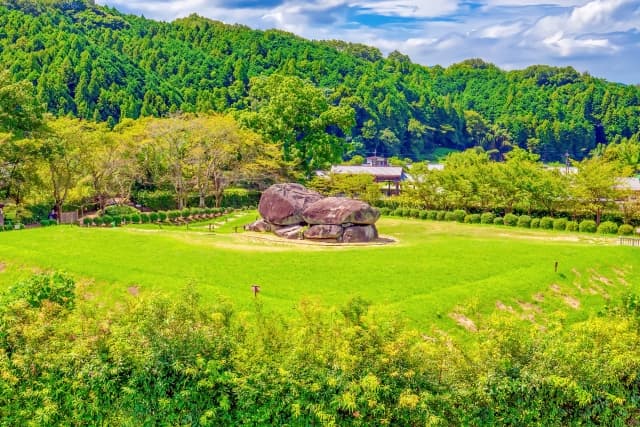
Asuka-dera was Japan's first true temple; its Great Buddha, one of the oldest Buddhist statues in the country, has sat in the same spot for some fourteen centuries. The Ishibutai tomb — one of Japan's largest square burial mounds, said to be the grave of Soga no Umako — has a vast chamber of exposed megaliths you don't forget. The Asuka Palace site was the stage of the Isshi Incident, the coup that led to the Taika Reforms.
Takamatsuzuka and Kitora are famous for their vivid tomb paintings. The paintings themselves were removed for preservation and are shown at nearby facilities — the courtly "Asuka Beauties," the blue dragon and white tiger, colours from thirteen centuries ago, still there to see.
Climb Amakashi Hill and the view opens: the three mountains of Yamato, and the palace sites and tombs scattered across the plain.
A whole landscape, protected
Asuka's greatest charm is that all of this still sits within a living countryside — burial mounds among the rice terraces, a palace site at the end of a field path. A special law protects the whole village's landscape, so there are no tall buildings and no garish signs. The feel of a scene more than a thousand years old remains intact. The fields and hills sung of in the Man'yoshu still hold the same skyline — few places in Japan can say that.
Asuka in autumn
Autumn deepens it. Around the equinox holiday, the terraces of Inabuchi are edged scarlet with red spider lilies. In October, cosmos sway across the wide field of the Fujiwara palace site. Where a capital once stood, flowers now bloom. These are not dead ruins; they live with the seasons.
As a base — 25 minutes from Gojo
Asuka is twenty-five minutes by car from yoinn, in Gojo — a place you can explore on foot or by rental bicycle, with half a day enough for the main sites. yoinn, in fact, sits between two World Heritage sites: to the south, the sacred sites and pilgrimage routes of the Kii mountains (Koyasan, Kumano, Yoshino); to the north, Asuka-Fujiwara. Walk the ancient capital by day, and by night, a quiet machiya — a way to touch the beginnings of Japan, gently, in a place tourism hasn't overrun.
Autumn across southern Nara — Asuka, Koyasan, Yoshino, the Mitarai Gorge — in one stay: see also The Other Nara.