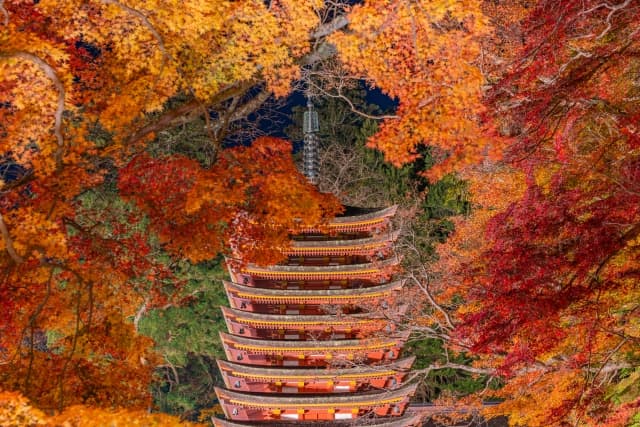
Most people come to Nara for the deer and the Great Buddha, and leave having "seen" Nara. But drive an hour south of the crowds and the landscape changes — the mountains deepen, the rivers run clear, and small towns appear that tourism never reached. On the map it looks like the space between destinations. It's the other Nara: Okuyamato, the deep south.
Autumn is when this land shifts most — water in September, flowers in October, colour in November — and, in every month, a quiet the rest of Nara doesn't have. Here is how the season moves.
September is still a season of water
In the late summer of September, water is still the main character. The Yoshino river runs just below the house; some mornings, mist lifts off it. Fifty minutes away, the Mitarai gorge in Tenkawa follows a walking trail past pool after clear pool, light flickering on the water. The Tanize suspension bridge in Totsukawa (45 minutes) links one hamlet to the next — a bridge people actually live by. Cross it, and all you hear is wind and water.
Around the equinox holiday, red spider lilies flood the rice terraces of Inabuchi, in Asuka (25 minutes) — scarlet edging the paddies, the rice still ripening. It looks like the archetype of a Japanese autumn.
North lies an ancient capital
Head the other way — twenty-five minutes north — and you reach Asuka. In 2026, the ancient capitals of Asuka and Fujiwara were inscribed as a UNESCO World Heritage Site: terraced fields and burial mounds, the landscape where Japan began. A little further on (35 minutes), the Fujiwara Palace site fills each October with cosmos — flowers swaying where a capital once stood.
yoinn sits between two World Heritage sites — the Kii mountains to the south (Koyasan, Kumano, Yoshino) and Asuka to the north.
The autumn colours arrive in relay
The colour here doesn't come all at once. From late October, the high ground of Koyasan (50 minutes) turns first. Into November, Yoshino (30 minutes) and Mitarai and Tenkawa (50 minutes) follow. By mid- to late November, the colour has drifted down to Tanize and Totsukawa (45 minutes).
So whenever you come, something is at its best. Choosing the mountain that's turning, on a single stay, is what one quiet base makes possible.
If you don't mind going further, there is Soni Kogen — about two hours out, near the eastern edge of the prefecture — a plateau where silver pampas grass catches the low autumn sun. It's one of the region's signature autumn sights.
Autumn is underfoot, too
You don't have to go far. Gojo is one of Japan's foremost persimmon towns; in autumn the slopes of Nishi-Yoshino colour with fruit and drying persimmons hang from the eaves. Local sake — Goshin — new rice, matsutake. Through October and November, small harvest festivals move through the villages.
And Shinmachi-dori, the street where the house stands, keeps an Edo-era townscape that is remarkably, almost improbably, quiet. At dusk, when a bar set inside an old sake brewery lights its lamps, the street goes quieter still.
Out by day, back by night
Travel here is a rhythm of leaving and returning. One group a day, the whole house yours. By day, the mountains, the rivers, the ancient capital. By night, back to a garden gone cool and a town that holds its silence.
For the full route — Koyasan, Tenkawa, Asuka, all three as single days from Gojo — see Three directions, one day.
This autumn, for stays of three nights or more, we'll take you into it — the drive is ours to plan. Tell us what draws you, and we'll build the route around it. First 10 groups. — The Other Nara, September to November.